

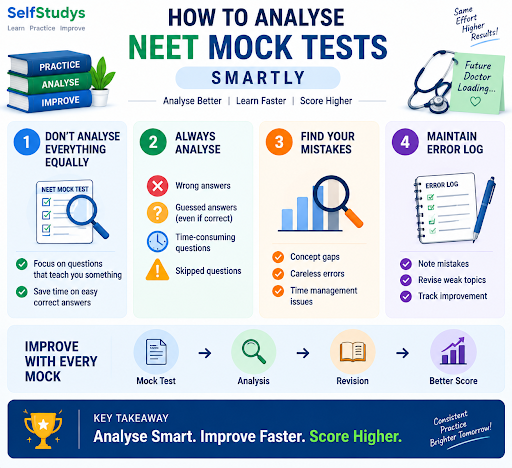
Every NEET aspirant is told the same thing: “Analysis is more important than the mock itself.” But that advice raises a very practical question. A NEET paper has 180 questions — do you really need to sit down and analyse every single one? Wouldn’t that take forever?
The honest answer is nuanced. You should analyse strategically, not mechanically. That means looking at far more than just your wrong answers — but it doesn’t mean re-examining all 180 questions with equal depth. Here’s how to get the balance right.
The Short Answer
No, you don’t need to deeply analyse every single question — but you must analyse many more than just the ones you got wrong.
The goal is to review every question that has something to teach you, while quickly passing over the ones that don’t. Done this way, your analysis is thorough where it counts and efficient everywhere else.
Why Analysis Is the Real Work
First, understand why this matters so much. Taking a mock only shows you a score; the learning comes from the review. In fact, analysis is roughly 80% of a mock’s value.
When you sit a NEET mock test, the real progress happens afterwards, when you work out why you lost marks and how to avoid it next time. Skip that, and you’ve wasted most of the benefit — no matter how many mocks you take.
Questions You Must Always Analyse
These are the questions that carry lessons, so never skip them:
- Every wrong answer. The obvious one. Understand exactly why you got it wrong — a concept gap, a misread, or a calculation slip.
- Every guessed or unsure answer, even if correct. This is the one most aspirants miss. If you guessed and got lucky, you don’t actually know that topic — treat it like a wrong answer. Getting it right by chance hides a real weakness.
- Every time-consuming question. If a question took you far too long, even if you solved it, that’s a speed problem to fix.
- Every question you skipped. Find out whether you skipped rightly or left easy marks on the table.
Together, these four categories are where all your improvement lives.
Questions You Can Safely Skip
You can pass quickly over one type: the questions you answered correctly, quickly, and confidently.
If you knew the answer instantly and got it right, re-analysing it teaches you nothing and only eats your limited time. A quick glance to confirm you were right for the right reason is enough. This is what saves you from spending five hours reviewing a three-hour paper.
How to Analyse Each Type Properly
For each question that deserves attention, don’t just read the correct answer — extract the lesson:
- For concept gaps: note the topic and go back to your notes or NCERT to relearn it.
- For silly mistakes: identify the pattern — misreading, unit errors, wrong option marking — so you can catch it next time.
- For slow questions: work out a faster method or decide it’s one to skip in future.
- For guessed answers: study the concept properly so next time it’s knowledge, not luck.
The point of analysis isn’t to admire the solution — it’s to change what you’ll do next time.
The Time Reality — Be Strategic
Analysing a full mock properly takes around two to three hours. If you tried to deeply analyse all 180 questions equally, it would take far longer and you’d burn out fast.
That’s exactly why the strategic approach matters. By analysing every question that teaches you something and skipping the easy correct ones, you keep your analysis both thorough and realistic — deep enough to improve, efficient enough to sustain mock after mock.
Keep an Error Log
As you analyse, record what you find. A simple error log — the topic, the type of mistake, and the fix — turns scattered observations into a clear pattern over time.
After a few mocks, your log will show you exactly which topics and mistake types keep recurring. That becomes your revision priority list, and it’s one of the most powerful tools in your preparation.
Apply the Same Approach to Previous Year Papers
This strategic analysis isn’t just for mocks. Use the same method on NEET Previous Year Question Papers: analyse your wrong, guessed, slow, and skipped questions, and pass over the confident correct ones. Because past papers reflect real exam patterns, analysing them this way is especially valuable for spotting the concepts NTA tests again and again.
A Simple Post-Mock Analysis Routine
Put it all together into a routine you can repeat:
- Note your overall and section-wise scores.
- Go through every wrong answer and understand why.
- Review every guessed or unsure answer, even correct ones.
- Flag slow and skipped questions and decide how to handle them next time.
- Skip the confident correct answers.
- Log every lesson, then revise the weak topics before your next mock.
Conclusion
So, should you analyse every question after a NEET mock test? Not every one, not equally — but far more than just your mistakes. The smart approach is to analyse every question that has a lesson (wrong, guessed, slow, or skipped) and quickly pass over the ones you nailed with confidence.
That balance keeps your analysis deep where it matters and efficient everywhere else — which is exactly what lets you learn the most from every mock, without drowning in review. Analyse strategically, log what you learn, and each mock will push your score a little higher.
Frequently Asked Questions
1. Do I need to analyse all 180 questions after a NEET mock? Not deeply. Analyse every wrong, guessed, slow, or skipped question, and quickly pass over the ones you answered correctly and confidently.
2. Should I analyse questions I got right? Only the ones you guessed or were unsure about — a lucky correct answer hides a weakness. Skip the confident correct ones.
3. How long should mock analysis take? Around two to three hours for a full mock when done strategically. Trying to analyse all 180 equally would take far longer.
4. Why analyse questions I already got right? Because getting an answer right by guessing isn’t the same as knowing it. Those are hidden weak spots worth fixing.
5. Should I keep an error log? Yes. Logging your mistakes reveals recurring patterns and gives you a clear revision priority list.
6. Does this apply to previous year papers too? Yes — use the same strategic analysis on past papers to spot the concepts NTA tests repeatedly.
