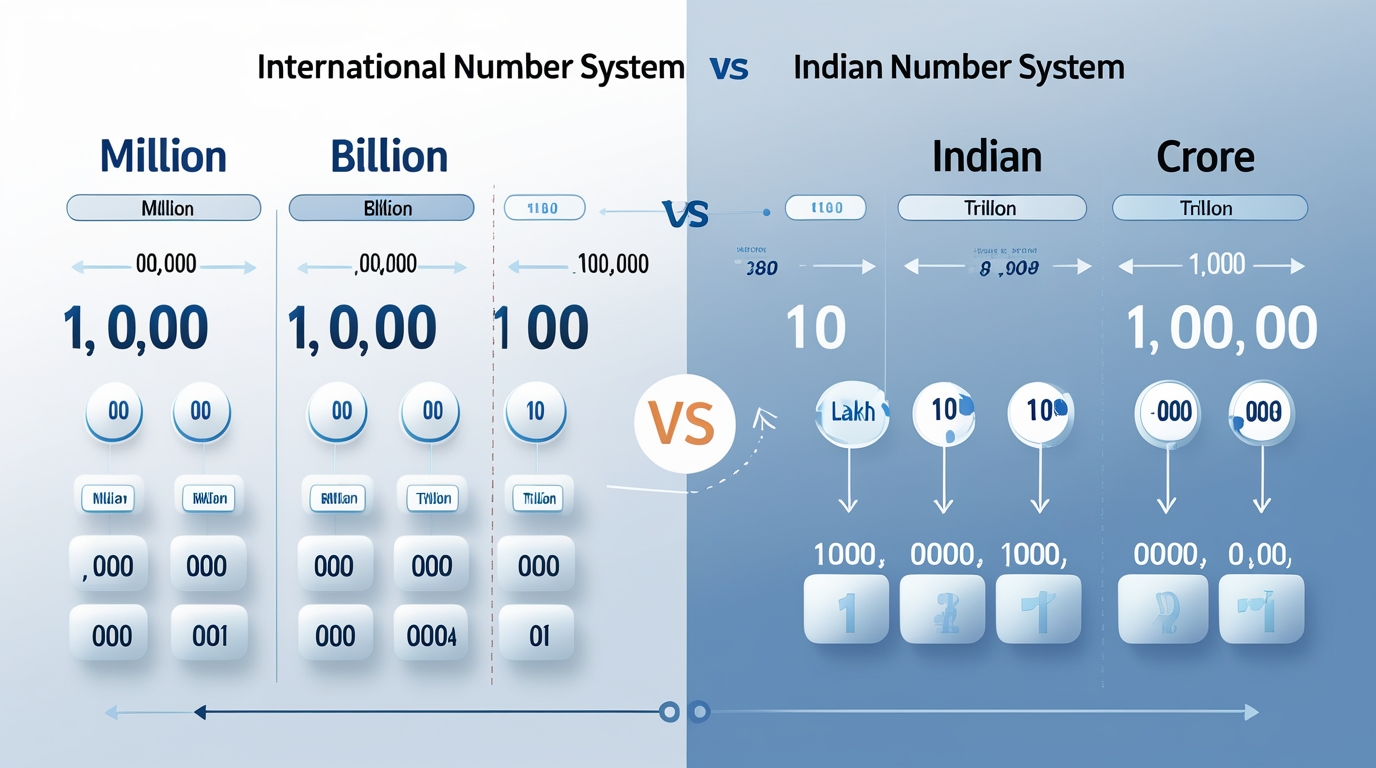
Understanding large numerical values is essential in today’s globalized economy, especially when comparing international financial data with Indian standards. Countries like the United States and those in Europe commonly use terms such as million, billion, and trillion, while India follows a different numbering system based on lakhs and crores. This difference can often create confusion for readers, investors, and businesses trying to interpret global financial information.
This article explains how large international numbers translate into Indian financial terms, offering clarity through practical examples, industry context, and real-world applications.
Understanding the Difference Between Numbering Systems
The international numbering system (also known as the Western system) groups digits in sets of three, such as thousands, millions, and billions. In contrast, the Indian numbering system groups digits differently after the first three digits, using terms like lakh (1,00,000) and crore (1,00,00,000).
Key Differences:
- 1 million = 10 lakh
- 10 million = 1 crore
- 1 billion = 100 crore
- 1 trillion = 1,00,000 crore
This variation is not just linguistic—it affects how financial reports, GDP figures, startup valuations, and investment data are interpreted in India.
Why Number Conversion Matters in Finance
In an interconnected world, financial data often crosses borders. Investors in India regularly analyze reports from global markets, multinational corporations, and international institutions. Without proper conversion, understanding the true scale of numbers can be misleading.
For example, when a global company reports revenue in billions, Indian readers may struggle to grasp its magnitude unless it is translated into crores. This is where billion to crore conversion becomes important for clarity and better decision-making.
Converting Millions into Crores
Basic Formula:
1 million = 0.1 crore
This means:
- 5 million = 0.5 crore
- 50 million = 5 crore
- 100 million = 10 crore
Million to crore conversion is frequently used in contexts such as startup funding, digital marketing budgets, and small-to-mid-scale international investments.
Practical Example:
If a startup raises 25 million dollars in funding, it translates to approximately 2.5 crore dollars in Indian terms (excluding currency conversion). This helps Indian stakeholders better understand funding sizes and growth potential.
Converting Billions into Crores
Basic Formula:
1 billion = 100 crore
This conversion is commonly used in large-scale financial discussions such as government budgets, multinational company revenues, and global investments.
Real-World Context:
If a company reports annual revenue of 3 billion dollars, it translates to 300 crore dollars. For Indian analysts, this conversion simplifies comparison with domestic companies that report figures in crores.
Understanding billion to crore conversion also plays a crucial role in interpreting GDP comparisons, international trade data, and corporate valuations.
Converting Trillions into Crores
Basic Formula:
1 trillion = 1,00,000 crore
Trillions are often used when discussing national economies, global markets, or large-scale financial systems.
Example:
India’s GDP is often discussed in trillion-dollar terms globally. However, when converted into Indian units, it becomes easier to relate to:
- 3 trillion dollars = 3,00,000 crore dollars
Trillion to crore conversion helps bridge the gap between global economic data and local understanding, especially for policymakers, economists, and financial analysts.
Role of Number Conversion in Business and Media
Large numbers frequently appear in:
- Financial news reports
- Stock market analysis
- International trade data
- Tech startup valuations
- Government economic policies
Without proper translation into familiar units, these numbers may lose their impact or be misinterpreted.
Example in Media:
A headline stating “Tech company reaches $1 billion valuation” may not resonate equally with all audiences. When expressed as “100 crore valuation,” it becomes more relatable to Indian readers.
Common Use Cases in the Indian Context
1. Startup Ecosystem
India’s startup ecosystem is deeply connected to global funding sources. Investment rounds are often reported in millions or billions of dollars. Converting these into crores allows founders, investors, and analysts to evaluate growth and scale more effectively.
2. Stock Market Analysis
Indian investors frequently track global markets such as the US stock exchange. Understanding company valuations in crores helps in comparing international stocks with domestic ones.
3. Government and Policy Reports
Economic reports released by global organizations like the IMF or World Bank use trillion-dollar metrics. Translating these into crores makes them more accessible for local policymakers and researchers.
Challenges in Interpreting Large Numbers
Despite straightforward formulas, several challenges remain:
1. Cognitive Gap
People are generally more comfortable with familiar units. A billion may seem abstract, while 100 crore feels more tangible.
2. Currency Conversion Confusion
Number conversion is often mixed with currency exchange rates, which can complicate understanding. It’s important to separate numerical conversion from currency valuation.
3. Inconsistent Reporting
Some platforms use mixed formats (e.g., millions alongside crores), which can confuse readers and reduce clarity.
Best Practices for Accurate Conversion
To ensure clarity and accuracy, consider the following:
- Always specify the unit clearly (million, billion, crore)
- Use consistent formats within a document
- Provide both international and Indian values when possible
- Avoid mixing currency conversion with number conversion
- Use simple formulas for quick understanding
These practices are particularly useful for content creators, financial analysts, and educators explaining global financial data.
Importance for SEO and Content Strategy
From an SEO perspective, number conversion topics attract consistent search demand, especially in regions like India where users frequently look for quick conversions.
Long-tail keywords such as:
- how to convert billion into crore
- difference between million and crore
- trillion to crore formula explanation
- international number system vs Indian number system
can drive targeted traffic when used naturally in content.
Including clear explanations, examples, and structured formatting improves both readability and search engine rankings.
Final Thoughts
Understanding how large international numbers translate into Indian financial terms is more than just a mathematical exercise—it’s a necessary skill in today’s data-driven world. Whether analyzing global markets, reading financial news, or evaluating business performance, accurate number conversion ensures clarity and informed decision-making.
By mastering simple formulas and applying them consistently, readers can bridge the gap between international and Indian numbering systems with ease. As global and local economies continue to intertwine, this knowledge becomes increasingly valuable for professionals, students, and everyday readers alike.