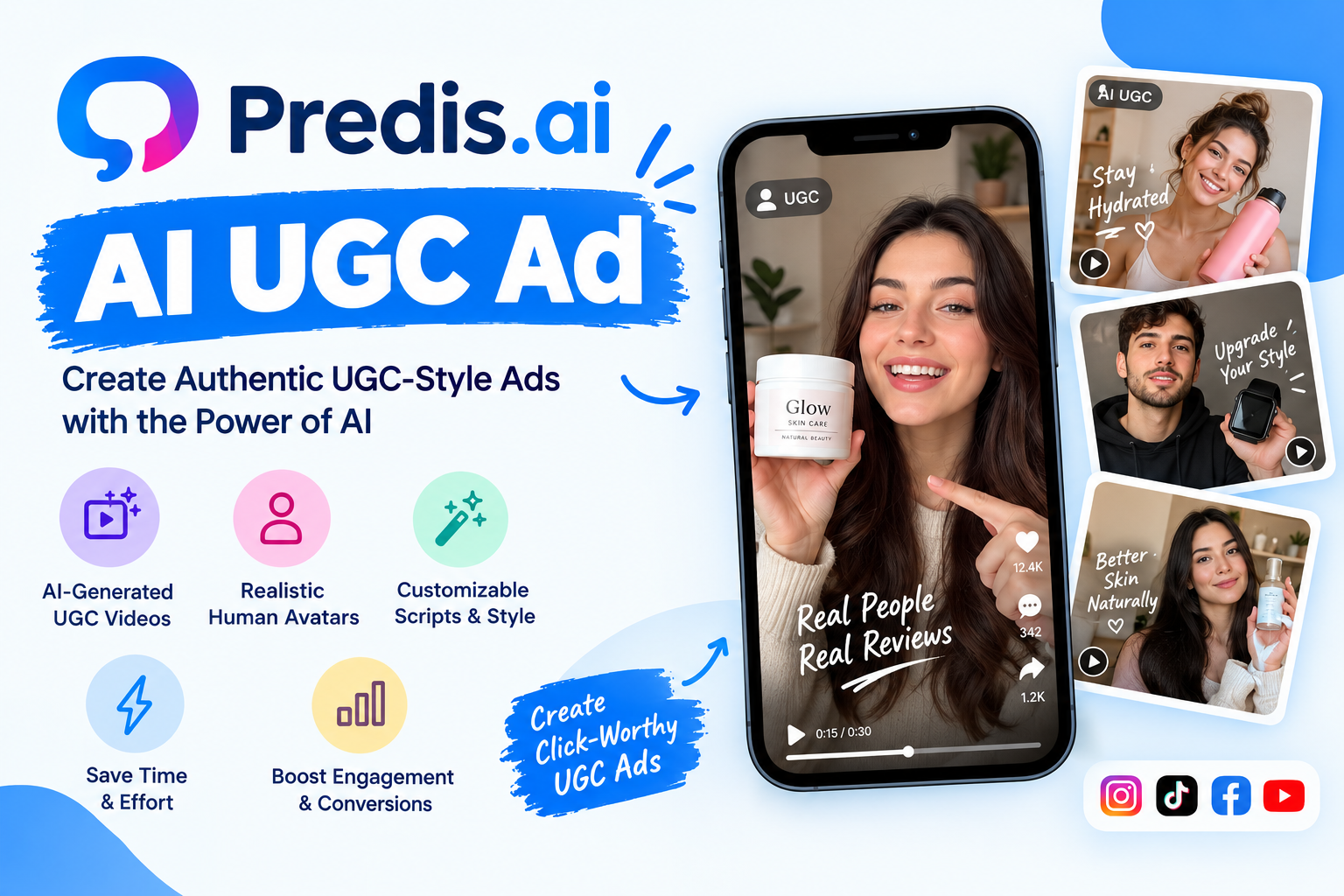
User-generated content (UGC) has become one of the most popular formats for digital advertising. Instead of looking like a traditional commercial, UGC-style ads feel more natural, relatable, and personal. They often feature a person introducing a product, sharing an experience, demonstrating how something works, or explaining why they like a particular product.
However, creating high-quality UGC ads traditionally requires planning, scripting, filming, editing, and sometimes hiring creators. AI-powered marketing tools are changing this process. One tool attracting attention in this area is Predis.ai.
A predis.ai AI UGC ad can help marketers explore an AI-assisted approach to producing UGC-style advertising content without relying entirely on conventional production workflows.
What Is a Predis.ai AI UGC Ad?
A Predis.ai AI UGC ad refers to a UGC-style advertising creative produced with the help of Predis.ai’s AI-powered content creation capabilities.
The basic concept is simple: instead of starting with a camera, physical location, actors, and a complete production setup, marketers can use AI-assisted tools to develop advertising concepts and creative assets.
UGC-style advertisements generally focus on authenticity and direct communication. A typical ad may begin with a problem, introduce a product as a solution, demonstrate its benefits, and finish with a call to action.
For example, an online skincare brand might create an ad around a simple concept:
“I was looking for an easier way to organize my skincare routine, and this product changed how I do it.”
The presentation is conversational rather than resembling a conventional television advertisement.
Why Are UGC Ads Popular?
Consumers are exposed to thousands of advertisements across social media, websites, search engines, and video platforms. Because of this, brands need creative formats that can capture attention quickly.
UGC-style advertising can make promotional content feel more like ordinary social media content. This is one reason many marketers experiment with UGC-inspired formats.
Some common characteristics of UGC ads include:
- Conversational language
- Short-form video
- Personal experiences or product demonstrations
- Strong opening hooks
- Simple visual presentation
- Clear calls to action
- Social-media-friendly formatting
The goal isn’t necessarily to make an advertisement look expensive. Instead, the creative often aims to make the message easy to understand and relatable.
How AI Can Change UGC Ad Creation
Traditional UGC production can involve several steps. A marketing team may need to develop an idea, write a script, find a creator, record footage, edit the video, add captions, and prepare different versions for different platforms.
AI can assist with several parts of this workflow.
A platform such as Predis.ai can help marketers approach content creation more systematically by combining AI-powered creative generation with social-media-oriented workflows.
For marketers, this can be particularly useful during the brainstorming stage. Instead of creating one advertising concept and stopping there, they can experiment with multiple hooks, messages, formats, and creative directions.
Key Elements of an Effective AI UGC Ad
Creating an AI-assisted UGC ad doesn’t automatically make the advertisement effective. The creative still needs a strong marketing structure.
1. Start With a Strong Hook
The first few seconds are important in short-form advertising.
A good hook should immediately communicate why the viewer should continue watching.
Examples include:
- “I didn’t realize how much time I was wasting until I tried this.”
- “If you’re struggling with this problem, here’s something worth knowing.”
- “Three things I wish I knew before buying this.”
The hook should be relevant to the audience rather than simply making exaggerated claims.
2. Identify the Problem
Strong UGC ads often focus on a specific customer problem.
For example, a productivity application could focus on people struggling to organize their tasks. A fitness product could focus on convenience. A software company could focus on simplifying a complicated process.
When the problem is specific, the audience can understand the purpose of the product more quickly.
3. Introduce the Product Naturally
Instead of immediately listing every feature, the product can be introduced as part of the solution.
This makes the advertisement feel more like a recommendation or demonstration.
For example:
“That’s when I started using this tool. It helped me put everything in one place.”
The exact wording should depend on the product and the target audience.
4. Show the Benefit
Features explain what a product does. Benefits explain why the customer should care.
An AI UGC ad should therefore focus on practical outcomes.
Instead of saying:
“Our platform has automated scheduling.”
A more audience-focused approach might be:
“You can spend less time arranging your schedule manually.”
The second statement connects the feature with a customer benefit.
5. End With a Clear CTA
The final part of the advertisement should tell viewers what to do next.
Examples include:
- Learn more
- Try it today
- Visit the website
- Explore the product
- Sign up
- See how it works
A clear CTA prevents the advertisement from ending without direction.
Predis.ai AI UGC Ad for Social Media Marketing
UGC-style advertising can be particularly relevant to social media because platforms such as Instagram, TikTok, YouTube Shorts, and Facebook prioritize short-form visual content.
A brand can develop different creative variations for different audiences and platforms.
For example, an e-commerce business might test:
Version A: Problem-focused hook
Version B: Product demonstration
Version C: Customer-benefit-focused message
Version D: Educational approach
Testing different concepts can help marketers understand which messaging resonates with their intended audience.
Advantages of Using AI for UGC-Style Content
One major advantage of AI-assisted content creation is speed.
Traditional production can require coordination between multiple people. AI tools can help reduce some of the time involved in ideation and content preparation.
Other potential advantages include:
Faster Content Ideation
AI can help generate different creative concepts and variations, which can be useful when a marketing team needs fresh ideas.
Easier Experimentation
Marketers can experiment with different headlines, hooks, scripts, and visual approaches without rebuilding an entire campaign from scratch.
Scalable Content Production
Businesses managing multiple products or social media accounts may benefit from a workflow that makes it easier to produce multiple creative variations.
Lower Production Complexity
AI-assisted workflows can reduce dependence on some traditional production steps, particularly during early creative development.
Things to Consider Before Using AI UGC Ads
AI-generated advertising also requires careful planning.
The biggest consideration is authenticity. UGC works partly because audiences associate it with real people and personal experiences. If AI-generated content feels artificial or makes unsupported claims, it can reduce audience trust.
Brands should therefore make sure their advertising is accurate and transparent.
Businesses should also pay attention to:
- Copyright and licensing
- Platform advertising policies
- Disclosure requirements where applicable
- Accuracy of product claims
- Brand consistency
- Appropriate use of AI-generated people or voices
AI should support a marketing strategy rather than replace good judgment.
How to Create a Better Predis.ai AI UGC Ad
A practical workflow could look like this:
Step 1: Define your audience.
Identify who the advertisement is intended for.
Step 2: Choose one problem.
Avoid trying to communicate everything in a single short video.
Step 3: Create several hooks.
Experiment with different ways of introducing the problem.
Step 4: Build the message.
Explain how the product addresses the problem.
Step 5: Add proof or demonstration.
Where appropriate, show how the product works or provide factual evidence for the claims.
Step 6: Add a CTA.
Tell the viewer what action to take.
Step 7: Test variations.
Compare different creative approaches using appropriate campaign metrics.
This process can make AI-assisted advertising more structured and purposeful.
The Future of AI-Powered UGC Advertising
AI is increasingly becoming part of the digital marketing workflow. Rather than treating AI as a complete replacement for marketers and creators, businesses can use it as a creative assistant.
The future of UGC-style advertising may involve a combination of AI-generated concepts, human-created content, real customer experiences, automated editing, and performance-based creative testing.
The important point is that technology alone doesn’t create a successful advertisement. The strongest campaigns still depend on understanding the audience, communicating a useful message, and building trust.
Final Thoughts
A predis.ai AI UGC ad represents an AI-assisted approach to creating UGC-style advertising content. For marketers, this type of workflow can make it easier to brainstorm ideas, develop creative variations, and produce social-media-focused advertising content.
However, effective UGC advertising is about more than simply generating content with AI. A successful ad needs a compelling hook, a clear customer problem, a relevant solution, accurate information, and a strong call to action.
As AI tools continue to develop, businesses will have more opportunities to experiment with scalable advertising workflows. The brands that combine these technologies with authentic messaging and thoughtful marketing strategies can create content that is both efficient to produce and relevant to their audiences.