

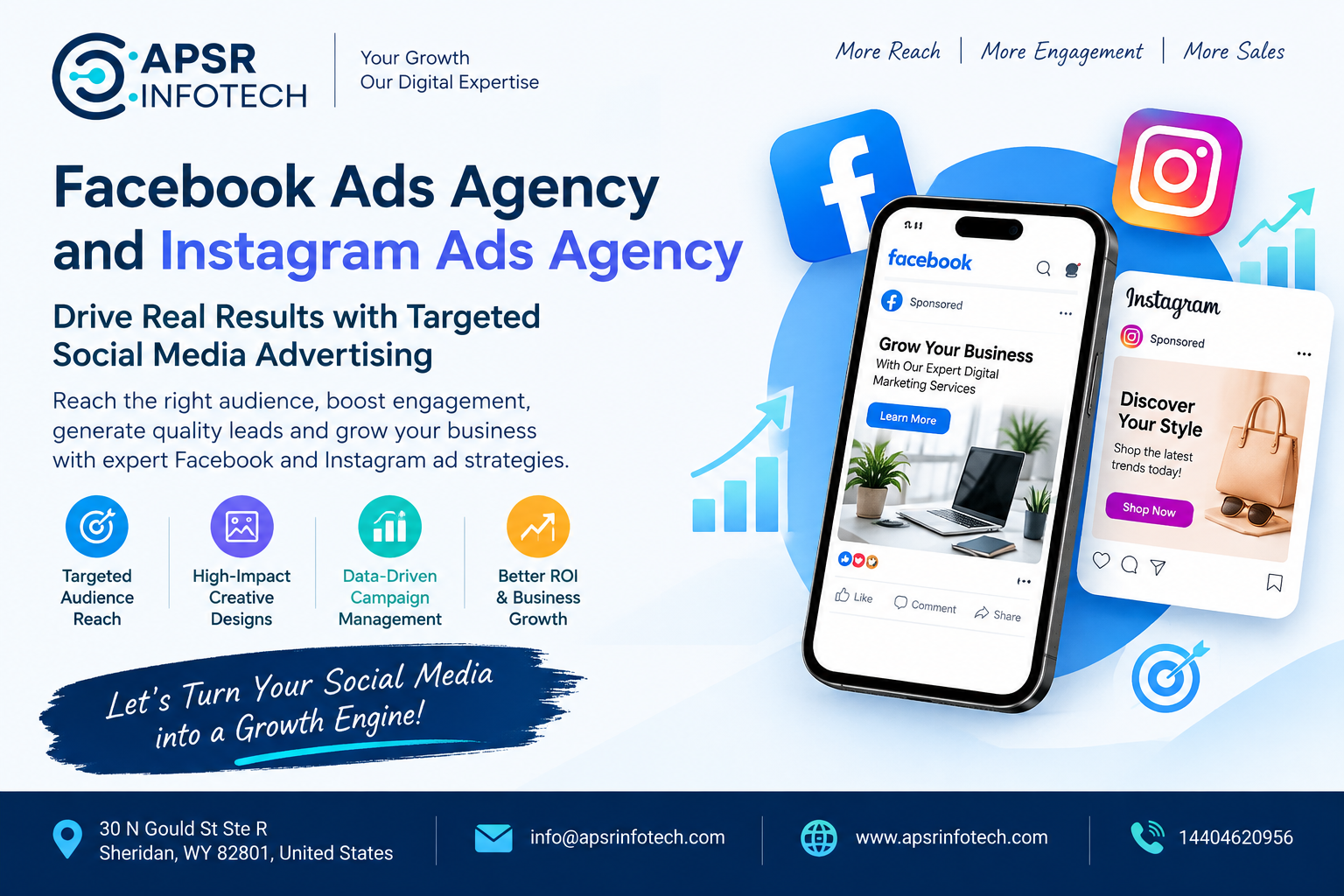
Facebook and Instagram have become important advertising channels for businesses that want to reach potential customers, generate leads, increase sales, and build brand awareness. However, simply launching an advertisement is not enough. Successful paid social campaigns require the right combination of audience research, creative development, campaign structure, conversion tracking, testing, and continuous optimization.
A professional Facebook Ads Agency and Instagram Ads Agency can help businesses turn advertising budgets into measurable marketing campaigns instead of relying on likes, impressions, or random boosted posts.
What Does a Facebook Ads Agency Do?
A Facebook advertising agency manages paid campaigns designed around specific business objectives. These objectives can include lead generation, online purchases, website traffic, app promotion, or brand awareness.
The work usually begins with understanding the business, target customers, offer, competitors, and conversion journey. The agency can then develop campaign structures, advertising messages, creative concepts, audience strategies, budgets, and tracking systems.
Modern Meta advertising is also becoming increasingly automated. Current industry guidance highlights simpler campaign structures, broader targeting, stronger creative variation, and reliable conversion signals as important parts of campaign management.
Why Businesses Need an Instagram Ads Agency
Instagram is particularly useful for businesses that can communicate their value visually. Products, services, lifestyle brands, restaurants, fashion businesses, real estate companies, professional services, and e-commerce brands can use formats such as Reels, Stories, Feed advertisements, and other placements to capture attention.
An Instagram Ads Agency can help adapt advertising creatives to the way people consume content on the platform. Instead of simply resizing one advertisement for every placement, campaigns can use platform-specific creative concepts, short-form videos, compelling hooks, testimonials, product demonstrations, and clear calls to action.
The goal is not just to generate attention. The creative should encourage the viewer to take the next step.
Facebook Ads vs. Instagram Ads: Which Should You Use?
Businesses do not always need to choose between Facebook and Instagram. Both platforms operate within Meta’s advertising ecosystem, allowing advertisers to build campaigns across multiple placements.
The better approach is to identify where the target audience responds and then use campaign data to guide budget allocation. For example, one creative may generate stronger engagement on Instagram Reels while another may produce more qualified leads through Facebook.
Instead of assuming that one platform will always perform better, advertisers should compare measurable business outcomes such as cost per lead, conversion rate, customer acquisition cost, revenue, and return on ad spend.
Creative Is a Major Performance Factor
One of the biggest developments in modern Meta advertising is the growing importance of creative quality and variety. Recent 2026 advertising guidance emphasizes creative testing, mobile-first formats, strong hooks, user-generated-style content, and frequent creative refreshes.
A strong campaign can test different headlines, offers, images, videos, testimonials, benefits, and calls to action. This creates useful performance data and helps identify which messages connect with different audience segments.
Creative testing should also be connected to the customer journey. Someone discovering a brand for the first time may need educational content, while someone who has already visited a product page may respond better to an offer or testimonial.
Tracking and Retargeting Matter
Advertising performance cannot be properly evaluated without reliable conversion tracking. Businesses should connect advertising activity with meaningful actions such as form submissions, purchases, calls, bookings, or qualified leads.
Retargeting is another important component. People who visited a website, interacted with content, watched videos, or started but did not complete an action can receive relevant follow-up advertisements.
Current Meta advertising strategies increasingly combine conversion data, automation, first-party information, and tools such as the Meta Pixel and Conversions API to improve optimization and measurement.
What Should You Measure?
A campaign should be evaluated according to its business objective. Important metrics may include:
- Cost per lead
- Cost per acquisition
- Conversion rate
- Return on ad spend
- Revenue generated
- Customer acquisition cost
- Landing-page conversion rate
- Qualified lead rate
- Creative performance
Focusing only on impressions or clicks can create an incomplete picture. A campaign with fewer clicks may still produce more valuable customers if those visitors have stronger purchase intent.
Common Facebook and Instagram Advertising Mistakes
Businesses often waste advertising budgets by launching campaigns without clear objectives, using weak creatives, making too many changes too quickly, ignoring landing-page performance, or failing to track actual conversions.
Another common problem is treating every audience the same. New prospects, returning website visitors, existing customers, and abandoned carts can require completely different messages.
A structured funnel helps businesses deliver more relevant advertising at different stages of the customer journey.
How to Choose the Right Advertising Partner
Before hiring an advertising agency, ask how campaigns will be measured, who owns the advertising account, how creative testing is handled, how often reporting is provided, and how the agency connects advertising results with actual business outcomes.
A good process should include strategy, campaign setup, creative testing, tracking, optimization, reporting, and ongoing improvement rather than simply launching advertisements and waiting for results.
Conclusion
Facebook and Instagram advertising can support lead generation, sales, customer acquisition, and brand growth when campaigns are built around clear objectives and measurable outcomes. The strongest approach combines compelling creative, appropriate audience strategy, reliable tracking, retargeting, continuous testing, and conversion-focused landing experiences.
If you are ready to turn paid social advertising into a structured growth channel, contact APSR Infotech today for a data-driven Facebook and Instagram advertising strategy tailored to your business goals.
In conclusion, choosing an experienced Facebook Ads Agency or Instagram Ads Agency is less about simply running advertisements and more about creating a complete system that connects audience research, creative, technology, tracking, and optimization. Get in touch today to discuss your advertising goals and build a measurable growth strategy.
